A running series on how Weavian works in practice — cloud anchoring, traffic classification, predictive path selection, and the security model that falls out of all of it.
Six posts. Each one goes deep on one layer of the stack.
Multi-cloud anchor portability, sub-second failover, stable egress IP.
Why we duplicate packets across every link instead of striping for throughput — trading bandwidth for sessions that don't break.
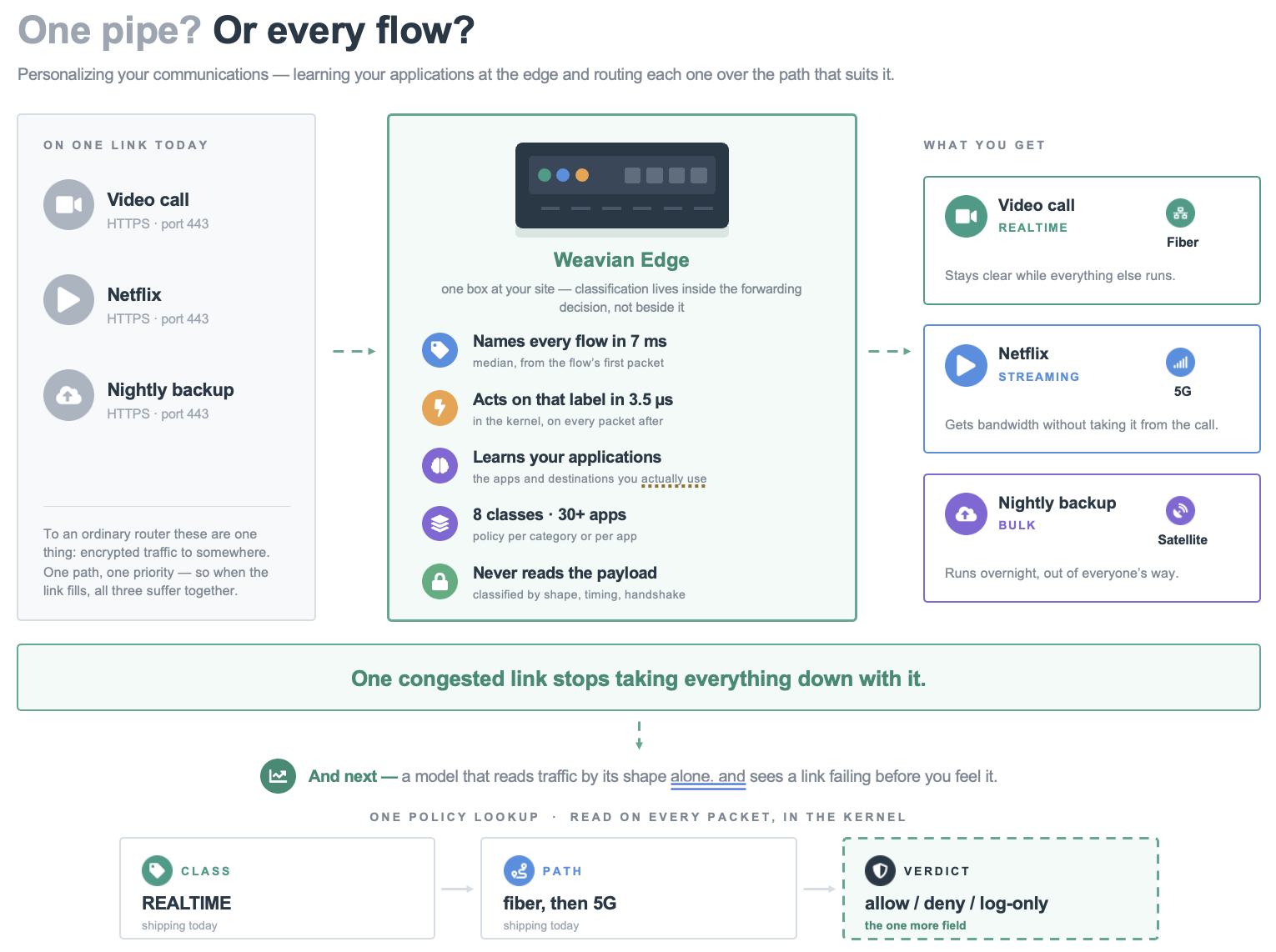
Naming every flow in 7 milliseconds and acting on the label in 3.5 microseconds — classification inside the kernel's forwarding decision, never in the payload.
Now that every flow has a name, failover stops being all-or-nothing. Move a single class, or a fraction of the load, instead of the whole site.
Spotting link degradation before it actually happens. Failover that starts before the failure does.
Turning a routing decision into an access decision. DDoS absorption, IP rotation, and per-application segmentation once portable anchors and intelligent routing live in the same stack.