The Weavian Platform

The product is the software.
The chassis is up to you.

Weavian is a multi-WAN bonding platform that runs on commodity x86 and ARM hardware. One software stack — one fleet, one console, one set of behaviours — across whatever box the deployment calls for. The intelligence lives in the engine. The form factor is whatever the environment needs.

RUNS ONx86 · ARM64 · Android DEPLOYS ASAppliance · OEM module · Container FOOTPRINTFrom a palm-sized box to a transit case
Architecture

A single stack, top to bottom.

The same five layers ship in every deployment. The in-kernel data plane, the bonding control plane, the traffic-intelligence layer, the cloud anchor fabric, and the fleet management plane — identical binaries, identical behaviour, whether the engine runs on a small fanless box at a branch office or a sealed case in the field.

05
Fleet management & consoleBrowser dashboard, SSH relay, OTA rollouts, registry of every edge.
04
Cloud anchor fabricStable public IP, NAT traversal, multi-region failover hubs.
03
Traffic intelligenceDPI classifier, per-class QoS, policy-driven WAN selection.
02
Bonding control planeHealth probing, scheduling, hitless failover, session preservation.
01
In-kernel data plane (eBPF)Line-rate encap/decap, WAN selection in kernel — userspace never touches a packet.

The same engine — wherever it lands.

A Weavian edge isn't a box. It's a software stack with well-defined interfaces. Plug in the WANs you have — fiber, 5G, Wi-Fi, LEO satellite — point it at a cloud anchor, and the bonded tunnel comes up before the operator finishes their coffee.

  • Hardware abstraction layer auto-detects every NIC, modem, and radio.
  • No per-chassis builds — the same binary runs on every supported board.
  • Built for Linux first; an Android client speaks the same wire protocol.
  • OEMs ship their own enclosure; Weavian ships the software.
Where it runs

Not a product line. A platform.

The same engine has run on a fanless mini-PC tucked behind a retail counter, on a vehicle gateway bolted into a broadcast van, on an industrial mini-PC at a remote energy site, and on an Android handset riding in a journalist's pocket. None of those are different products. They're the same software, on whatever box the environment called for.

That's the design centre. Customers don't pick a SKU; they pick a chassis. If you have hardware you'd like to put Weavian inside, we ship it as a sealed software image or a container. If you'd rather hand the integration off to us, we have one piece of first-party hardware — and it's Mission Anchor, sitting just below.

One software stack, one fleet plane, one set of behaviours — the box is whatever the operating environment can afford to look like.
Why software-first

The chassis is a commodity. The engine isn't.

Hardware vendors compete on price; software vendors compound on capability. Weavian builds the engine and lets the market choose the box — which keeps the moat in the algorithms, the wire protocol, and the fleet plane, not in the metal. A fix shipped to a branch router lands on the rugged variant the same day, because there is only one branch and one rugged variant of the code.

The economics follow from that. The platform earns its keep on whatever box the customer can already buy, OEMs and integrators bundle it inside their own products, and the entire fleet — every edge, every region, every chassis — phones home to the same control plane. Push a policy, roll a build, retire a node — from one console, across the whole installed base.

First-party hardware

If you want the box too — we make one.

Mission Anchor is the one chassis Weavian ships under its own name. Same engine as everything above, hardened for the worst day on the job: IP67 transit case, four bonded WAN paths, Starlink-ready, power-on to online in under sixty seconds.
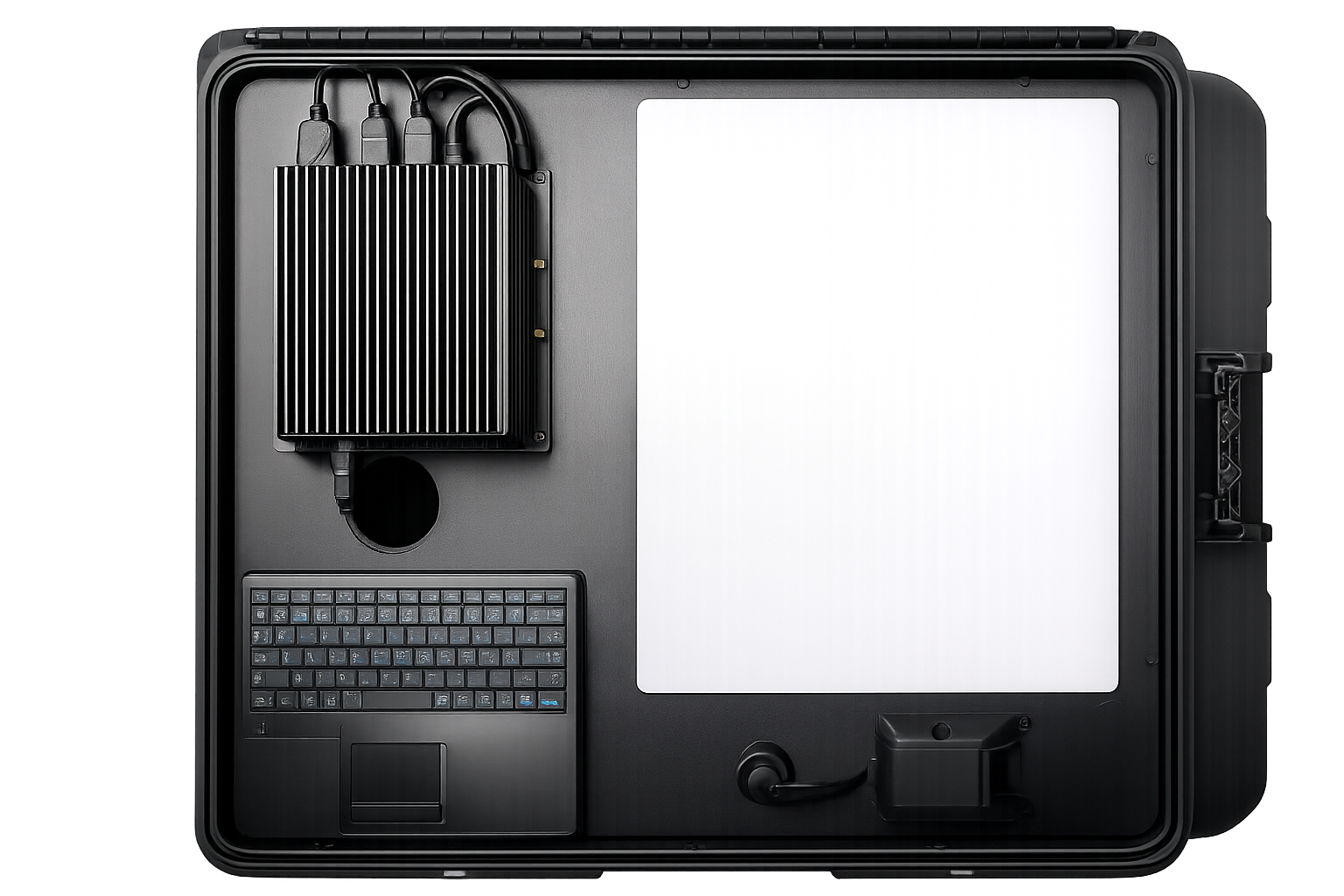
Mission Anchor — open interior
NABX-RGD-01 · Mission Anchor

The platform, in a transit case.

Open the lid, power up, walk away. The bonded uplink is running before the latches close. Built for field crews, broadcasters, emergency responders, and mission teams who can't afford for the connection to be the variable.

IP67 NANUK-9604× WAN + Wi-Fi< 60s boot9-36V DC
Explore Mission Anchor
› TWO WAYS IN

Deploy the platform.
Or build on it.

If you have a deployment that needs an unbreakable uplink, we'll size it with you. If you build hardware and want bonding inside it, let's talk about licensing the engine.